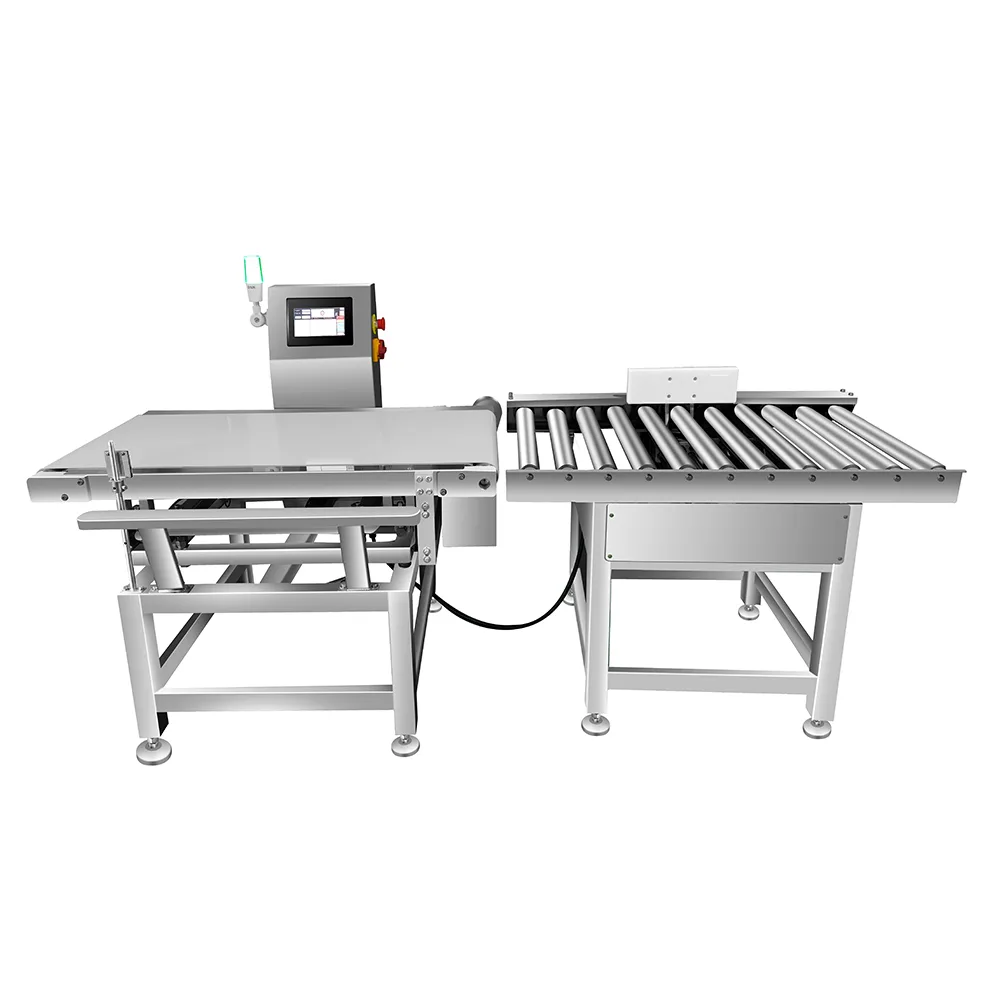
A conventional industrial scale and a checkweigher both determine product weight, but they serve different roles on a manufacturing floor. A scale generally provides a weight reading for an operator or process, while an automated checkweigher measures products as they move through production and can make an immediate accept-or-reject decision.
For manufacturers deciding between the two, the critical difference is therefore not simply weighing accuracy. It is what happens before, during, and after the measurement.
The Weighing Task Comes First
An industrial scale is often used when a product, container, ingredient, or finished item can be placed on a weighing platform. The operator or production system receives the measured value and can then decide what action is required. This arrangement suits processes where weighing is occasional, batch-based, or performed at a defined workstation.
A checkweigher operates within a different environment. Products travel across a conveyor, pass over a weighing section, and are measured without being manually placed on a platform. Easyweigh describes its checkweigher as an automated weighing system that measures products in real time while they move along a conveyor.
That distinction changes the role of the equipment. A scale primarily answers, “How much does this item weigh?” A checkweigher is designed to answer a more operational question: “Does this product meet the specified weight while production is running?”
Why a Production Line Needs More Than a Weight Reading
Production lines rarely stop for every individual weight check. Packaged food, pharmaceuticals, agricultural products, and other manufactured goods may need to move continuously from one stage to another. Manual weighing at a stationary scale can interrupt that flow and create additional handling.
A checkweigher is built around continuous movement. Easyweigh’s product range includes general-purpose dynamic systems with working speeds listed from 20 to 90 meters per minute, depending on the model and application.
Weight limits can also be incorporated into the inspection process. A product outside the configured range can be identified automatically rather than requiring an operator to interpret each reading. Easyweigh states that its systems can verify packaged products against specified weight ranges and reject products that do not meet those requirements.
The difference becomes particularly useful when every package needs to be checked. Instead of sampling a portion of production at a stationary weighing station, manufacturers can place automated weighing directly into the product path.
Where a Checkweigher Takes Over the Process
A checkweigher does not simply record weight. It combines measurement with programmed product handling. Once a product passes over the weighing section, the system determines whether its measured value falls within the accepted range.
Such an arrangement can identify underweight and overweight products while production continues. Easyweigh also describes checkweighing systems that can detect missing parts in products, making weight measurement useful for identifying incomplete packages or portions.
Product format influences the appropriate configuration. Small packages may require a high-speed system designed for low weight ranges, while large cartons or heavy packages require a different weighing capacity and mechanical structure.
Easyweigh lists high-speed systems for products with checking ranges up to 50 g and heavy-weight models with capacities up to 60 kg.
An industrial scale can certainly provide the required weight value in these situations, but it does not automatically provide the same continuous inspection workflow. The surrounding production equipment and control logic determine whether the measurement becomes an automated quality decision.
The Difference Becomes Clear at the Reject Point
Automatic rejection is one of the clearest distinctions between conventional weighing and production-line checkweighing. A stationary scale normally leaves the operator responsible for deciding what to do with an item outside the target range.
A checkweigher can connect the measurement result directly to a rejection mechanism. Easyweigh identifies pushers, air jets, and diverters among available rejection methods, with the appropriate mechanism depending on the product and production arrangement.
That connection reduces the gap between detection and action. An underweight package can be removed from the acceptable product stream immediately, while production continues with the next item.
Integration can extend beyond weight control. Easyweigh states that its in-line checkweighers can be integrated with other inspection equipment, including metal detectors and X-ray systems. Such integration can consolidate several inspection functions within a continuous production process.
Accuracy Has a Different Meaning on a Moving Line
Accuracy remains important for both types of equipment, but production-line weighing adds other variables. Product spacing, conveyor speed, package stability, weighing range, and mechanical handling can influence the measurement environment.
Easyweigh lists nominal accuracy specifications as tight as ±0.1 g for certain small‑range checkweigher models, while its general‑purpose dynamic systems are listed at ±0.3 g to ±1 g depending on the configuration.
Note: ±0.1 g applies only to limited low‑weight measuring ranges under ideal test conditions. Real‑world dynamic weighing performance is affected by product weight, line speed and factory‑floor environmental conditions.
These figures should not be treated as universal performance values for every product. The suitable system depends on the actual weight range, product dimensions, line speed, and required tolerance.
For manufacturers, the important question is therefore whether the equipment can maintain the required weighing performance while products remain in motion. That is fundamentally different from evaluating a scale only by its static measurement capability.
Choosing the Right Weighing System for Production
The comparison between a checkweigher and an industrial scale becomes straightforward once the production task is defined. A conventional scale is appropriate when products can be brought to a weighing station and the measurement can be handled manually or as part of a batch process.
A checkweigher becomes more appropriate when products need to be weighed automatically during continuous production. It combines in-line measurement with weight-limit decisions and can automatically remove products that fall outside the accepted range. Easyweigh offers configurations covering small products, general production requirements, and heavy packages.
Easyweigh’s checkweighing solutions are designed for applications across food, pharmaceutical, agriculture, cosmetics, and other production environments. The choice should still be based on the actual product rather than the industry label alone.
Ultimately, the deciding factor is not whether one machine can weigh more accurately than another. The key question is whether weighing is a separate task or an active part of production control.
When products must be measured, evaluated, and potentially rejected without interrupting the line, a checkweigher provides a fundamentally different solution from a stationary industrial scale.
