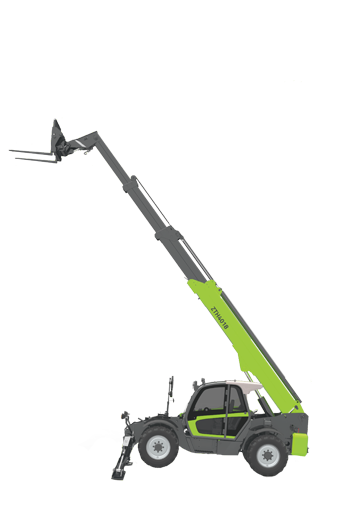
A telehandler quotation is more useful when job requirements are defined before contacting a supplier. A practical brief should cover load weight, lifting height, forward reach, site access, terrain, attachments, operating environment, delivery location, and timing. For buyers considering an off road telehandler, these details help manufacturers match the machine to the actual work instead of a headline capacity alone.
Define the Job Before the Machine
Start with the material-placement tasks. List the heaviest and typical loads, load dimensions, pickup and placement points, lift heights, and maximum forward distance. OSHA guidance emphasizes load dimensions, weight, center of gravity, working height, boom length, load radius, and travel clearance when assessing telehandler lifting operations. A written task profile gives the manufacturer a usable basis for the quotation.
Separate routine requirements from occasional peak lifts. Giving both figures lets the supplier explain capacity limits at different boom positions and prevents the quotation from being based only on an average or maximum load.
Map the Site for an off road telehandler
Record ground type, slopes, soft or uneven areas, entrances, overhead obstructions, excavation zones, traffic routes, and operating space. WorkSafe guidance recommends assessing site suitability, equipment size, rated capacity, load dimensions, and ground conditions before equipment is chosen.
Measure the travel route as well as the working area. Include gate widths, height restrictions, turning space, unloading areas, and the distance between storage and placement points. Note whether the machine will travel frequently with loads or mainly position materials from fixed locations.
Clarify Attachment and Load Requirements
Include attachments in the first request. State whether the work needs forks, a bucket, lifting hooks, or another approved attachment, and provide attachment size and weight where known. OSHA notes that operators need to understand manufacturer-approved attachments and their effects on equipment operation.
Ask for the load chart that applies to each proposed attachment and task. A telehandler’s available capacity changes as the boom extends, so the quotation should address the actual load, lift height, forward reach, and attachment combination. As the extension length of the boom increases, the maximum lifting capacity will decrease accordingly.
Specify the construction telehandler Operating Environment
Describe whether the machine will operate on construction sites, industrial yards, farms, warehouses, or mixed locations. State surface conditions, weather exposure, duty cycle, operating hours, and whether the unit will move between sites. The term construction telehandler should reflect the actual work environment and handling requirements.
For multi-country projects, provide destination markets early because certification, documentation, language, shipping, and service requirements may differ. Also record fuel availability, storage, maintenance access, noise expectations, and operator arrangements.
Prepare a Complete Commercial Brief
An RFQ should state quantity, destination, target delivery date, purchasing entity, and whether the request covers one machine or a fleet. Clarify whether freight, commissioning, operator training, spare parts, warranty terms, and service support should be included. A complete brief makes supplier responses easier to compare.
For international purchases, ask what delivery scope the quotation assumes and which documents are included. Confirm lead-time assumptions, transport dimensions, and final-access limitations.
Review a construction telehandler Quote Against the Job
When quotations arrive, compare more than price. Check rated capacity, capacity at required lift height and forward reach, dimensions, operating weight, turning radius, travel performance, attachment compatibility, and documentation. The proposed machine should be evaluated against the job profile you supplied.
Then review warranty coverage, parts availability, manuals, training, and after-sales response. These items do not replace technical fit, but they can affect deployment and support throughout the equipment’s working life.
Check the ZTH4018 Against the Brief
For requirements calling for a larger non-rotating machine, Zoomlion Access lists the ZTH4018 in its telehandler range. Their official specifications state a maximum lift height of 17.6 m, rated capacity of 4,000 kg, lift capacity of 2,500 kg at maximum height, and maximum forward reach of 13.4 m. At maximum reach, the listed lift capacity is 850 kg.
The ZTH4018 has an overall length of 6.48 m, width of 2.28 m, height of 2.57 m, and weight of 12,700 kg. The specification also lists a 3.8 m outside turning radius, ±10° frame leveling angle, hydraulic transmission, and front-wheel, four-wheel, or crab steering. The model is CE certified and uses Cummins QSF 3.8/Cummins F3.8 engines.
Build the Quote Request for Zoomlion Access
A focused RFQ to Zoomlion Access can include project location, maximum and typical loads, load dimensions, required lift height, forward reach, attachment type, ground conditions, access measurements, quantity, delivery target, and local compliance requirements. Sending these details together gives their team a clearer basis for matching the request to the available telehandler range. Their current product portfolio includes non-rotating and rotating telehandlers.
For the ZTH4018, buyers can use the published figures as a starting reference, then ask their team to confirm the applicable load chart, attachment configuration, delivery scope, and documentation.
Confirm Scope Before Ordering from Zoomlion Access
Before accepting a quotation, check that the machine configuration, attachment, capacity data, delivery terms, warranty, and documentation match the original request. For the off road telehandler requirement, confirm that the quoted configuration is appropriate for the intended terrain and site conditions rather than assuming the base machine covers every application.
A final comparison should show what is included, what is optional, and which assumptions the supplier used. With those items documented, Zoomlion Access can respond to a more complete requirement, while the buyer has a stronger basis for comparing the quotation with other equipment options.
