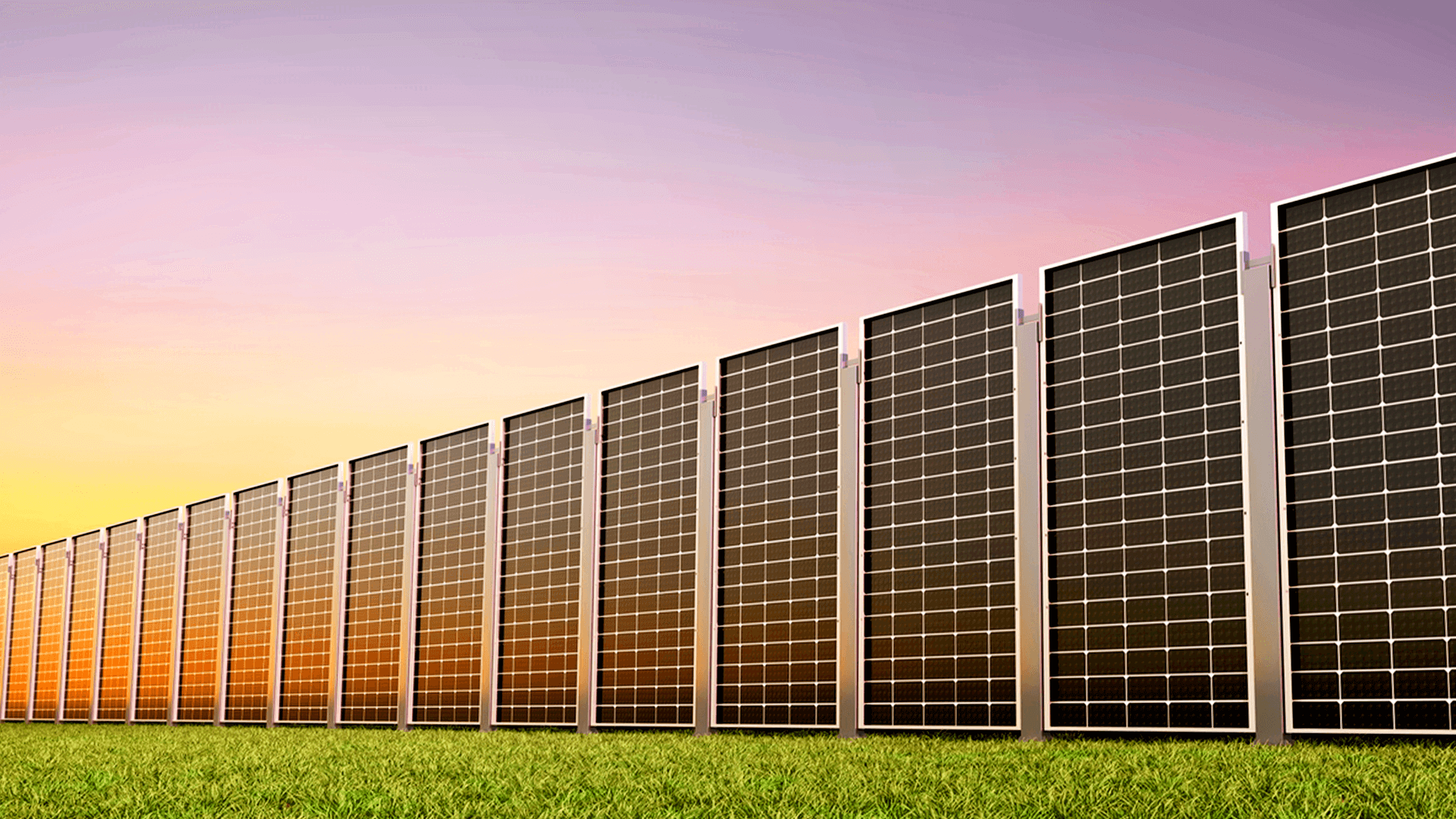
Vertical bifacial arrays capture irradiance on two upright faces, creating a production profile that differs from conventionally tilted modules. Depending on orientation, climate, albedo, and surrounding obstructions, output may shift toward morning and afternoon hours while using a narrow strip of land.
A vertical solar panel mount can improve useful bifacial yield when geometry preserves rear exposure and the operating environment suits the configuration. Antaisolar‘s vertical ground solution is intended for land-constrained locations such as pastures, fences, highways, and guardrails, where generation can share space with boundary functions.
Understanding the Vertical Irradiance Profile
A vertically oriented bifacial array with an east-west alignment can receive direct irradiance on different module faces at different times of day, often increasing the relative contribution of morning and afternoon generation. This can create two daily production peaks rather than a single midday peak. The actual benefit depends on latitude, weather, horizon, row spacing, and electricity-value profile.
Diffuse sky light and ground-reflected irradiance contribute to both sides. Snow, light gravel, dry soil, grass, crops, and pavement have different and changing albedo. Energy estimates should use seasonal data and three-dimensional shading rather than a fixed rear-gain percentage borrowed from tilted arrays.
Vertical orientation may reduce dust or snow accumulation on the glass, but it does not eliminate soiling. Road spray, agricultural activity, vegetation, bird contamination, and windborne particles can affect either face. The accessibility of both surfaces makes inspection and cleaning strategy an important design input.
Antaisolar describes its vertical structure as occupying less space while maintaining efficient energy capture and capturing sunlight effectively. Project modeling should test those outcomes against the selected bifacial module, orientation, row pitch, boundary geometry, surface condition, and local weather file.
Coordinating Structure, Spacing, and Land Use
Upright modules experience wind from either side and may create different pressure patterns near corners, openings, slopes, and traffic corridors. Posts, rails, clamps, foundations, and edge distances require site-specific structural checks, with deflection limits that protect glass, frames, cables, and required clearances.
Row spacing must prevent one vertical line from shading the next during valuable hours. When the mounting line also serves as a fence, it needs gates, end conditions, livestock or public safety provisions, vegetation clearance, and access for electrical isolation and repair.
Tailor-made design and customized production are available from Antaisolar for different requirements. This flexibility can address post spacing, enclosure height, terrain steps, module dimensions, foundation method, and interface details, but every variation should remain within validated connection configurations or be supported by project-specific structural calculations and required testing.
Cable routing is especially visible and accessible in vertical installations. Conductors and connectors need protection from animals, vehicles, maintenance tools, standing water, sharp edges, and unauthorized contact. Grounding, bonding, warning labels, and equipment clearances should follow the applicable electrical and safety framework.
Measuring Whole-Project Energy Value
Annual kilowatt-hours alone may not capture the value of a shifted production curve. Morning and afternoon output can align differently with demand, market prices, storage dispatch, or feeder constraints. Analysis should compare hourly energy, clipping, curtailment, losses, and the cost of the vertical structure and foundations.
Land-use value also enters the decision. Pasture continuity, fencing, highway boundaries, guardrails, access strips, or agrivoltaic operations may continue beside generation. Permitting, visual impact, safety setbacks, glare, drainage, and ecological requirements can determine whether that shared use is practical.
Antaisolar places vertical mounting within a wider portfolio that includes conventional ground arrays, carports, agrivoltaics, and Fishery PV systems. Comparing these options on the same site helps developers understand whether vertical geometry, another dual-use form, or a conventional layout produces the strongest combined outcome.
A project using a vertical solar panel mount performs best when irradiance modeling, structural design, electrical safety, land function, cleaning, and hourly energy value are evaluated together. The configuration should be selected for a documented site advantage rather than for novelty, with early operational data used to compare actual performance against the modeled generation profile.
