Material selection can significantly affect the performance, appearance, and usability of a resin 3D printed part. For businesses using additive manufacturing for prototypes, models, fixtures, product development, or functional components, the choice between rigid and elastic materials should therefore be based on the intended application rather than simply printability. Comparing flexible resin with standard resin provides a practical way to understand how different material properties influence production decisions.
Understanding the Difference in Material Behavior
Standard resin is generally selected when dimensional stability, surface quality, and straightforward printing are important. SUNLU Standard Resin is positioned as an entry-level liquid resin for stable and reliable printing, balancing accuracy and ease of use. Its current specifications list a Shore hardness of 86D, tensile strength of 45 MPa, flexural strength of 57 MPa, and elongation at break of 13.5%.
These characteristics make standard resin suitable for many everyday models where a relatively rigid finished part is preferred. Its viscosity is listed at 300–600 mPa·s/℃, while the recommended layer exposure time is 4–15 seconds for color LCD screens and 1.5–3.5 seconds for monochrome LCD screens. Such parameters can help businesses establish repeatable printing workflows when using compatible equipment.
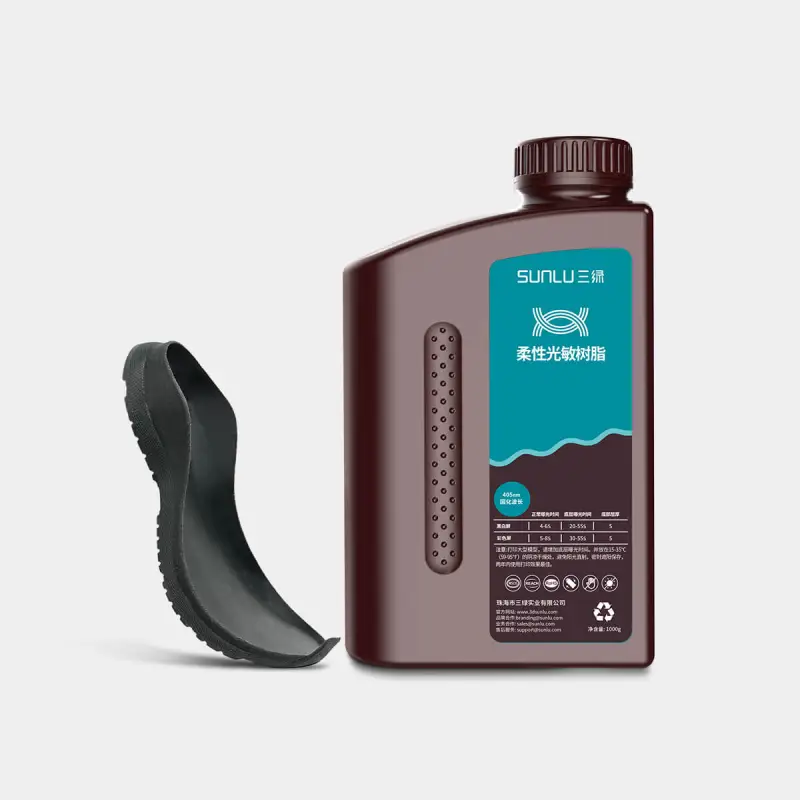
Flexible resin, by contrast, is designed for applications where a printed part needs to deform and recover instead of remaining rigid. SUNLU Flexible Resin has a Shore hardness of 70A, tensile strength of 4 MPa, and elongation at break of 130%. The manufacturer also describes its printed parts as flexible and durable, with tear and impact resistance suited to functional models requiring elasticity.
Where Flexible Resin Has a Practical Advantage
For components that need compression, stretching, bending, or repeated deformation, flexible resin can offer material behavior that standard resin cannot readily provide. SUNLU describes its Flexible Resin as having a silicone-like feel, high elasticity, and rebound performance. The product is therefore positioned for applications such as seals, gaskets, and other parts where shape deformation is part of normal use.
The difference is particularly relevant to business product development. A prototype intended to represent a soft-touch component or flexible interface may need to reproduce not only the geometry but also a degree of physical compliance. A rigid material can reproduce the shape, but its mechanical response may differ substantially from the intended component.
SUNLU Flexible Resin also has a listed resin viscosity of ≤2,000 mPa·s/℃ and recommended layer exposure times of 8–30 seconds for color LCD screens and 5–10 seconds for monochrome LCD screens. Its published specifications list 5–10 bottom layers and a lifting speed of 60–90 mm/min.
When Standard Resin Makes More Sense
For businesses producing general-purpose prototypes, visual models, miniatures, or other rigid parts, standard resin may be the more straightforward material choice. SUNLU Standard Resin emphasizes smooth flow and stable molding, with the manufacturer stating that its formulation is designed to support reliable printing and a higher printing success rate.
Its mechanical profile also illustrates why it behaves differently from an elastic formulation. With 45 MPa tensile strength and 57 MPa flexural strength, the material is substantially more rigid than the 70A flexible formulation. Its 13.5% elongation at break also indicates considerably less stretch before failure.
For organizations where consistent detail and uncomplicated production are priorities, these characteristics can make standard resin a practical option. The material is available in multiple colors and package sizes, including 333 g, 500 g, 1,000 g, 2,000 g, 3,000 g, and 4,000 g options on SUNLU‘s product page.
Choosing Resin 3D Printing Materials by Application
There is no universal winner between the two materials. The better choice depends on what the printed component must do after production. A rigid housing, display model, or general prototype may benefit from standard resin, while a gasket-like component, flexible interface, or deformation-resistant functional model may require an elastic material.
For procurement and engineering teams, the selection process can begin with several questions: Does the part need to bend or stretch? Is tactile softness important? Will dimensional rigidity matter more than elasticity? How frequently will the component be subjected to deformation or impact? These questions help connect material properties with actual operating requirements.
Businesses should also consider printer compatibility and validated exposure settings before adopting a material for production workflows. Resin 3D printing performance depends not only on the resin itself but also on printer configuration, exposure, layer thickness, post-processing, and part geometry. Manufacturer-recommended parameters provide a starting point, but production users should validate settings on their specific equipment.
Making a Material Decision for Production
For business users, the most appropriate resin is ultimately the one whose physical behavior aligns with the intended part and workflow. Standard resin can support stable, rigid everyday printing, while flexible resin is better suited to designs where elasticity, rebound, and a softer tactile response are central requirements.
SUNLU provides both material categories as part of its broader 3D printing materials portfolio. Its Standard Resin focuses on stable, accessible printing, while Flexible Resin targets elastic functional models with a 70A Shore hardness and 130% elongation at break.
For companies evaluating materials for prototyping or repeated resin 3D printing, comparing mechanical requirements with actual application conditions can make the selection process more systematic. Rather than asking which material is simply better, engineering and purchasing teams can identify which formulation provides the appropriate balance of rigidity, flexibility, printability, and finished-part performance for each project.
